

This excerpt is part of Carolina Nursing’s 75th Anniversary series, “From the Vault.” It was originally published in the Spring 2005 issue of Carolina Nursing magazine.
by Norma Hawthorne
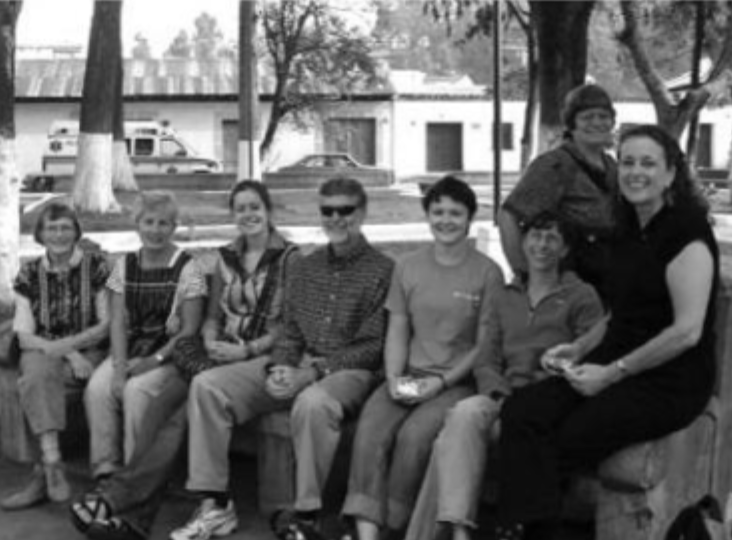
We first met via e-mail and then at the home of one of our travelers, Dr. Carol Klein, a physician at Piedmont Community Health Clinic, to prepare for a 10-day healthcare culture and language immersion in Guatemala in October 2004. Those making the trip to Guatemala included a group of student preceptors and faculty from the SON, Wayne Sherman, a public health department nurse administrator, Jane Amold, an assistant professor and director of mid-wifery at UNC Health Care, Noreen Ordronneau, a UNC Hospitals nurse, and Elena Lamanna and Jessica Sherman, two recent college grads exploring a future in public health and nursing.
SON clinical faculty instructor Christina Harlan, MS, RN, a fluent Spanish speaker with in-depth experience providing healthcare to migrant workers and immigrants, organized and led this trip. She served as our interpreter and guide along with Blanca Ortiz, our in-country resource expert. Harlan led the first successful SON-organized study abroad program for students during spring break in March 2004.
The intention was to expand our cultural competence and sensitivity towards the Latino immigrant population in North Carolina through an intensive immersion program, which involved studying Spanish and living with a host family. By doing so, we hoped to become better prepared to serve and gain a greater perspective on the patient-provider relationship. We could not have anticipated how all the nuances and subtleties we were exposed to would alter and improve our understanding of immigrants and their healthcare needs.
We were based in Antigua, the ancient historical capital at the center of Spanish colonial influence in Central America. The cobbled 16th-century streets were lined with imposing villas stuccoed in hues of mango, plum, turquoise, and rose.
Around the Parque Centrale, shops attracted vacationers from Guatemala City and tourists from Europe. The shop windows displayed textiles, jewelry, carved jade masks and hand-tooled leather bags. On the streets, young Mayan women with babies wrapped in slings held close to their breasts were accompanied by weather-scarred grandmothers looking much older than their actual years.
They wore ornately embroidered huipiles identifying their indigenous villages, a practice carried over from the Spanish conquerors, imposed to control mobility. The street corners and market stalls hummed with vendors offering musical instruments, paintings, rugs and shawls.
Guatemala is an under-resourced nation on the road to recovery after a protracted civil war in which Mayan villages were hard hit. In 1996, a peace treaty was negotiated, and a newly elected democratic government pledged to improve education and healthcare services, especially for the rural underserved. In addition to studying Spanish each day with a personal tutor, we visited public and private health clinics and hospitals, an
HIV/AIDS hospice primarily serving children ages six months to 21 years, a traditional nurse midwife, and a Western-style birthing and midwife training center, where we could experience and discuss firsthand the services provided and the needs still to be met. Our hosts, health professionals and leaders, were welcoming, energetic and hopeful. Their explanation of how the public healthcare system is organized in Guatemala gave us a clearer view of how our immigrant clients access care in North Carolina clinics and hospitals.
We learned that the tiered-access public health system is intended to provide broad basic services to rural populations. Then, by referral, a complex or urgent case could be admitted to a regional hospital or clinic and then, by another referral, to the only public tertiary care hospital in the country, located in Guatemala City. People living in remote areas depend on farming for their family income, rely on traditional folk medicine, have a limited need for more than basic education, and must overcome complex cultural and geographic barriers to consider accessing healthcare and education. Most community health is provided by either lay technicians or nurse auxiliaries who receive about six months of training. A traveling physician or graduate nurse may visit a village clinic periodically for health check-ups and vaccinations.
Graduate nurses, who study for three years at the one university in Guatemala that grants the degree, are few. Graduate nurses are more likely to be employed in the higher-salaried private healthcare system serving patients who are insured or are able to pay out-of-pocket. As a result, the populations in highest need have more limited access.
Over the course of the week, we visited more than 11 public and private health clinics and hospitals, talking with practitioners and administrators. Maternal and child health continually surfaced as a top priority. Pre-natal screenings, adequate midwife training (60% of births are outside a hospital), malnutrition, the highest rates of spinal bifida in the world, upper respiratory infections and high morbidity and mortality in newborns were the most frequently mentioned areas of need for health promotion and prevention. Unemployment is pervasive and one out of every three people earns less than $1 a day.
Because rural life depends so heavily upon agriculture as a means of economic support, the men who perform the labor are first in line for nourishment. Often, infants and nursing mothers eat last so that those who labor to provide the food are sustained. Community life depends on it. It is usual for animals to be raised to sell rather than be eaten, and one chicken may be shared by a family of eight or nine children once a week during a Sunday meal.
During the week, over a meal or at the end of the day, we talked about our experiences and explored how healthcare attitudes, perceptions and behaviors of immigrants are based on the culture and experiences in their country of origin. We also discussed our own perceptions and attitudes about delivering competent care and how the Guatemalan experience had influenced us and altered our beliefs. We brainstormed ways to improve health communications within our own institutions and reframe educational messages. We also talked about how important an experience this was for us and for our SON students. It was an eye-opener for us to see how compassionate care is being delivered in a developing nation by non-governmental agencies and by the state.
We were able to contrast it with our own Western approach to the delivery of care, which is very scientifically and technologically grounded. We shared how the experience develops empathy, self-confidence and cultural sensitivity by introducing the participants to the unfamiliar:
“Understanding the conditions here leaves no excuse at home for not being a better, more empathetic provider,” said one traveler. Another said, “Through this experience, I will be more sensitive to the people I care for. Immigrants have an entire history behind them that a study abroad program helps us understand.” We all agreed that the University’s priority for an international study abroad experience for students is essential and needs to be supported, and that a learning experience of this magnitude could not be gained in any other way.

From the Vault — Carolina Nursing’s first graduates

From the Vault — Elizabeth Kemble: Founding Dean and Nursing Visionary

From the Vault — Elizabeth Scott Carrington: Visionary of Carolina’s First Nursing School
