
June 18, 2026
As telehealth, remote monitoring, and artificial intelligence-powered health tools become increasingly integrated into healthcare delivery, a new study published in JAMA Network Open introduces the first comprehensive national measure designed to assess whether communities are prepared to benefit from digital health services.
Approximately 100 million Americans live in areas with inadequate access to healthcare, with rural and underserved communities facing some of the greatest barriers. While digital health technologies can help bridge these gaps, successful adoption depends on more than internet access alone.
The Digital Health Index (DHI) is an AI-powered, validated census tract–level measure of community digital health readiness that combines socioeconomic conditions, healthcare access, and digital connectivity. The study analyzed data from more than 85,000 census tracts across all 50 states and the District of Columbia. The findings reveal that many communities identified as digitally vulnerable differ substantially from those flagged by existing measures of social vulnerability, deprivation, or broadband access alone.
“When we compared the results of the DHI against the indices health systems and policymakers already use, we found that more than half of the communities with the greatest digital health vulnerabilities simply don’t appear in those existing tools. That’s not a data quality problem; it’s a blind spot with real consequences,” said Saif Khairat Ph.D., MPH. “Health systems that allocate digital health resources using only existing indices miss the majority of the communities that need support most. The DHI was built specifically to close that gap.”
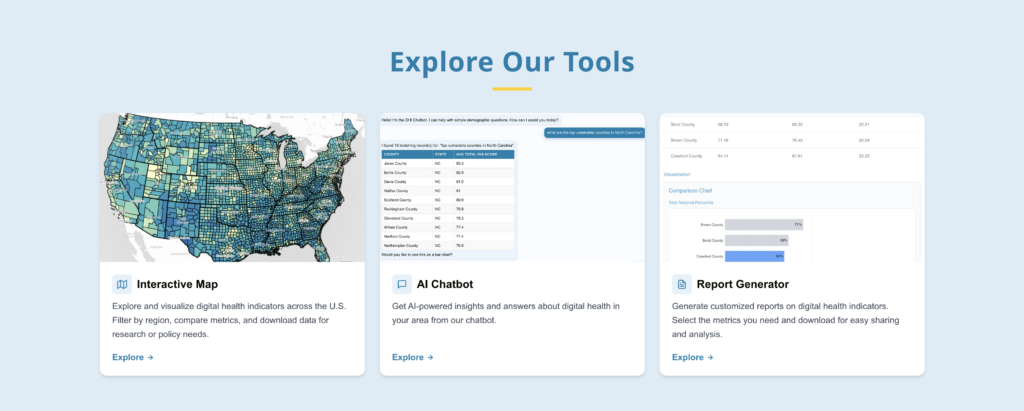
The AI-powered DHI tool can serve as a valuable planning and evaluation tool as healthcare organizations increasingly invest in digital care delivery. The tool can be used to identify communities that may require digital literacy support, device assistance, or broadband investments.
Digital health is becoming an essential component of healthcare delivery. Measuring community readiness will be essential for ensuring equitable access to emerging technologies.
Khairat led a multidisciplinary team from the UNC Schools of Medicine, Nursing, and Global Public Health, UNC Health and UNC Library to develop the DHI through the NIH-funded Center for Virtual Care Value and Excellence (ViVE Center). A Beerstecher-Blackwell Distinguished Professor at the School of Nursing, he also serves as Chief Artificial Intelligence Officer and Vice Provost for AI at UNC-Chapel Hill.
