
Publication and presentation roundup — Summer 2026
The latest scholarly work from the UNC School of Nursing
Carolina Nursing faculty, staff, and students are actively sharing their research findings on critical health care topics through publications in academic journals, presentations at national and international conferences, and features in various media outlets, including articles, podcasts, and more.
Take a look at the selection of publications, presentations, and media features below to learn more about how Carolina Nursing experts are advancing health for all by addressing the greatest health care challenges of our time.
Please note that the following list was compiled based on information submitted by our researchers and is categorized into presentations and publications.
Have a publication, presentation, or media feature to share to share? School of Nursing faculty, students and staff can submit information here to be included in the next roundup.
Publications
Isabel Roth, DrPH, MS, Paula Tomczak, DNP, and Jennifer Leeman, DrPH, MPH, MDiV, were part of a research team that explored the implementation of Integrative Group Medical Visits for patients with chronic pain in safety-net primary care settings. The researchers interviewed 21 clinicians, administrators, staff members, and an evaluator from 10 safety-net settings across the United States.
The analysis identified implementation determinants related to 12 constructs within the updated Consolidated Framework for Implementation Research. Findings showed that Integrative Group Medical Visits are adaptable and may produce long-term savings, but they are also complex, involve up-front costs, and may not align with existing workflows. Partnerships, clinician-advocates, Group Visits Coordinators, clinician training, novel financing approaches, and adaptation for telehealth delivery may help support implementation. The study also identified novel determinants, including the complexity of the model, the critical role and motivation of clinician-advocates, and the importance of training for those delivering the intervention.
Published in JAMA Internal Medicine, Mindfulness-Based Group Medical Visits for Persons With Chronic Low Back Pain: A Randomized Clinical Trial included Isabel Roth, DrPH, MS, as part of a research team that conducted a randomized clinical trial of a telehealth-delivered mindfulness group medical visit program for people with chronic low back pain. The trial included 451 patients receiving care at general internal medicine and family medicine clinics in Massachusetts, Pennsylvania, and North Carolina.
Compared with usual care, the eight-week mindfulness intervention resulted in statistically significant improvements in pain intensity and interference at eight weeks, six months, and 12 months. However, the differences between the groups did not meet the study’s prespecified mean minimal clinically important difference at any time point. The program incorporated primary care clinicians, was accessible, and is potentially scalable as a nonpharmacologic treatment for chronic low back pain.
For Roth, the study supports a broader goal of expanding access to this type of care: “It’s time to make mindfulness accessible for folks with chronic pain and related chronic conditions. My work is about how we make this happen.”
Neuro‑Based Teaching: A Practical Strategy Nurse Educators Can Use Tomorrow
A new publication from the UNC School of Nursing’s Paige Randall, PhD, RN, CNE, and Nancy Jo Thompson, DNP, MSN-Ed, RN, in Nurse Educator highlights practical ways nurse educators can apply neuro-based teaching and learning principles to strengthen clinical judgement, skilled know-how and practice readiness.
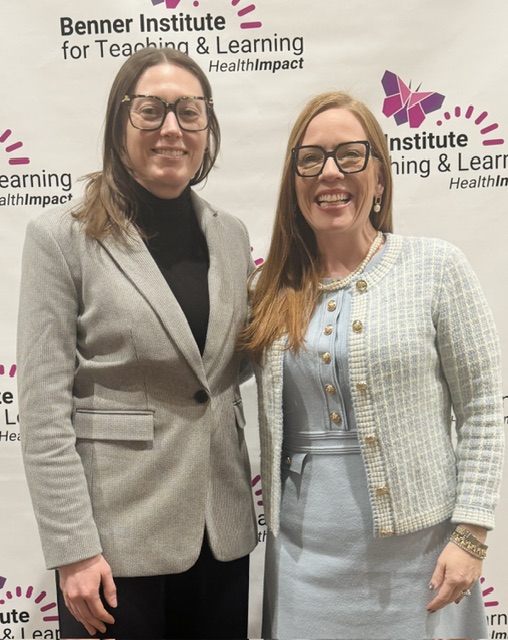
In “Neuro-Based Teaching: A Practical Strategy Nurse Educators Can Use Tomorrow,” the authors contribute to an emerging area of nursing education scholarship focused on neuro-based teaching and learning and offer educators a practical approach they can use immediately in classrooms, simulation, clinical learning environments and academic–practice partnerships.
“One of the things I’ve appreciated most as a new faculty member at UNC School of Nursing is the commitment to innovative teaching. Our article shows that small, intentional changes, grounded in neuroscience, can have a meaningful impact on how nursing students learn, think, and prepare for practice,” said Randall.
This publication grew out of their invited national breakout session, “Practice Readiness Hackathon: Neuro-Based Designs for Clinical Experiences That Build Clinical Judgment,” at the 2026 Educating Nurses: A Radical Transformation Conference, hosted by the Benner Institute for Teaching and Learning and the International Consortium for Outcomes of Nursing Education (ICONEd).
During the interactive session, Drs. Randall and Thompson engaged academic–practice partners and faculty from across the country in a mini-hackathon to address practice-readiness challenges in nursing education. Participants worked in small academic–practice teams to identify recurring pain points, such as “checkoffs without conceptual grasp” and “clinical that doesn’t stick,” and then reframed these issues as formation-focused teaching challenges.
The session reflected ICONEd’s clinical education vision and the broader call for radical transformation in nursing education by emphasizing rich dialogue, collaborative design, and rapid-cycle ideas that can be tested in academic and practice settings, Dr. Thompson said.
“What if each of us made one small shift—teaching in ways that align more closely with how our students learn?” Thompson said. “Small, intentional changes can increase engagement, strengthen learning and ultimately support a safer transition into practice.”
Risk and Protective Factors of Perinatal Depression in Perinatal Latinas: a Systematic Review
Alyssa A. Portes, Lisa N. Mansfield, PhD, RN, Taleah Frazier, and Yamnia I. Cortés recently published a systematic review examining the prevalence, risk factors, and protective factors associated with perinatal depression (PND) among Latinas in the United States.
Following PRISMA guidelines, the review analyzed studies published between 1987 and 2025 that assessed depressive symptoms during pregnancy through 12 months postpartum among Latina adults. Across the 17 studies included, reported rates of perinatal depression varied widely, with higher risk linked to factors such as socioeconomic disadvantage, discrimination, history of depression, and acculturative stress. Protective factors included social support, familismo, spirituality, resilience, and other culturally rooted sources of support.
The review also found that Latinas remain underrepresented in perinatal mental health research despite experiencing some of the highest rates of perinatal depression and the lowest rates of screening and treatment.
This work highlights the need for culturally tailored, bilingual screening and family-centered interventions to better support perinatal mental health and reduce disparities in care for Latina mothers and families.
A health policy analysis of di(2-ethylhexyl) phthalate (DEHP) in medical products and devices
Julie Jacobson Vann, PhD, MS, RN, teamed up with a Duke School of Nursing graduate student, Dr. Christeanna Richardson, and three faculty members, Drs. AnnMarie Walton, Valerie Sabol, and Malinda Teague, on a health policy analysis. Dr. Richardson completed this Doctor of Nursing Practice project as part of our larger health policy advocacy plan aimed at banning select plastic medical supplies made with di(2-ethylhexyl) phthalate and 11 related phthalate plasticizers from use in North Carolina health care delivery. The paper, A health policy analysis of di(2-ethylhexyl) phthalate (DEHP) in medical products and devices, Brief report, was accepted in The Journal for Nurse Practitioners on May 19, 2026.
Dr. Julie Jacobson Vann began working on this advocacy plan in May 2024, at the request of a North Carolina legislator’s wife. This project is relevant and important because of the importance of educating nurses about conducting health policy analyses and the need to promote safe and healthy workplaces for nurses and the patients or clients they serve. Many medical supplies are made with polyvinyl chloride, which is softened and made more flexible by adding phthalates, such as di(2-ethylhexyl) phthalate (DEHP). Patients, nurses, and other health care workers are exposed to these toxins through dermal, inhalation, ingestion, and/or parenteral administration. Phthalates are classified as carcinogenic, mutagenic, reprotoxic, and endocrine-disruptors. On March 31, 2025, NC House Bill 592, Toxic-Free Medical Devices Act of 2025, was introduced in the NC General Assembly. The Senate version was signed into law on July 3, 2025 by Governor Josh Stein.
Suzanne Thoyre, PhD, RN, FAAN; Jinhee Park, PhD, RN; and Jamie Crandell, PhD, examined the strategies parents use to support feeding among children at risk for feeding disorders during their first 24 months. The researchers collected longitudinal data from 220 parents of 257 infants who required neonatal intensive care through online questionnaires administered at nine points between one and 24 months post-term age.
Brent J. Small, PhD, and colleagues examined how anxiety develops over time among cancer patients with a high symptom burden during active treatment. Using four anxiety assessments from 534 patients, the researchers identified three distinct trajectories: a low-anxiety group, a high-anxiety group with substantial variation, and a medium, stable-anxiety group.
Cathi Propper, PhD, and colleagues reviewed research on the development of fear learning during childhood, a period of peak developmental plasticity and substantial change in the neural circuitry underlying fear learning. Disruptions and atypical development in these systems may be mechanisms underlying childhood psychopathology.
Prenatal Sleep Quality, Neonatal Brain Volume, and Infant Emotion at 6 Months of Age
Cathi Propper, PhD, and colleagues examined associations among prenatal sleep, neonatal brain regions involved in emotional regulation and psychopathology, and infant negative affect at 6 months. The study included 103 pregnant people from the Brain and Early Experience Study. Maternal sleep was assessed at approximately 28 weeks of gestation, infant brain anatomy was evaluated by MRI at 2 weeks postpartum, and infant negative affect was measured at 6 months.
Theresa Raphael-Grimm, PhD, PMHCNS-BC, and colleagues developed a Collaborative Online International Learning (COIL) module designed to increase nursing students’ comfort with identifying and discussing racism in healthcare. The module responds to the need for international, cross-cultural approaches that prepare students to recognize racism and understand how biases can interfere with compassionate care.
Kea Turner, PhD, MPH, MA, PhD student Ryan Chi-Hsuan Su, MSN, RN, Brent J. Small, PhD, Emma Hume, MPH; Olivia Sprow, MPH, and colleagues explore the challenges of managing nutrition after CRS-HIPEC.
The researchers interviewed 20 colorectal cancer survivors who had undergone CRS-HIPEC within the previous three to 12 months and 10 caregivers at a single cancer center. Participants reported that nutrition-related symptoms—including diarrhea, early satiety, and pain—were more severe and lasted longer than expected. Survivors experienced anxiety and frustration when purchasing, preparing, and eating food, while caregivers struggled to apply nutrition guidance and wanted resources such as recipes and meal plans tailored to the survivor’s surgical procedure. The timing and continuity of support from registered dietitian nutritionists also affected participants’ readiness to manage nutrition independently.
The findings suggest that early, proactive support from registered dietitian nutritionists may help survivors and caregivers address nutrition challenges following CRS-HIPEC. The researchers recommend testing interventions that provide early nutrition counseling and education tailored to surgical factors, including the presence of a colostomy.
Stage of Disease Among Hospitalized Persons Living With Dementia: A Multisite Study
Mark Toles, PhD, RN, FAAN, and colleagues examined dementia stage and factors associated with disease stage among hospitalized older adults with Alzheimer’s disease and related dementias. The researchers analyzed data from 6,303 adults aged 55 years and older who were identified at admission across five U.S. medical centers.
Among the hospitalized patients, 39.3% had mild dementia, 57.8% had moderate dementia, and 2.9% had severe dementia. Compared with patients with mild dementia, those with moderate dementia were more likely to be older, identify as Black, and have an Alzheimer’s disease diagnosis. Patients with severe dementia were more likely to identify as Black or Asian and have an Alzheimer’s disease diagnosis. Those with moderate or severe dementia were less likely to be admitted to subspecialty or surgical services.
The findings show that moderate-stage dementia was the most common stage among hospitalized patients with Alzheimer’s disease and related dementias. Identifying patients’ dementia stage and related characteristics may help guide hospital-based interventions designed to improve their care.
Jihye Kim Scroggins, PhD, RN, and colleagues examined whether synthetic data could improve natural language processing models designed to identify stigmatizing language in obstetric clinical notes. Because these models require human-annotated datasets—which can be scarce—the researchers used Llama-3 to generate synthetic examples of language categorized as “Difficult Patient” and “Questioning Patient Credibility.”
The team generated synthetic data using zero-shot, few-shot, and fine-tuned few-shot approaches, and nurse researchers evaluated its quality. The fine-tuned few-shot approach produced the highest-quality synthetic data. When synthetic data was added to real-world birth admission notes, ClinicalBERT’s F1-score increased from 0.88 to 0.95 with 10% augmentation for “Difficult Patient” and from 0.68 to 0.82 with 50% augmentation for “Questioning Patient Credibility.”
The findings demonstrate the potential for synthetic data to address data scarcity and improve tools that identify stigmatizing language in clinical notes. These tools could provide measurable indicators to help inform policy.
Saif Khairat, PhD, MPH, and colleagues developed the Integration of Telehealth and In-Person Services survey to assess telehealth integration and its facilitators from health care providers’ perspectives. The survey addresses the need for a measure of integration in hybrid health care environments, where poorly coordinated in-person and telehealth services may increase workloads, reduce provider satisfaction, contribute to burnout, and hinder quality-improvement efforts.
Using an exploratory sequential mixed-methods design, the researchers conducted semi-structured interviews followed by two rounds of participant-informed, modified-Delphi surveys. Interviews identified indicators of integration involving visit-modality decisions and provider and staff workflows. They also identified influencing factors such as leadership priorities related to quality and access, physical space, scheduling systems, and staff support.
The resulting survey includes 22 items measuring the extent of telehealth integration within a practice environment and 31 items assessing factors that influence integration. The survey has undergone content-validity assessment and is ready for psychometric testing to evaluate additional types of validity.
Presentations
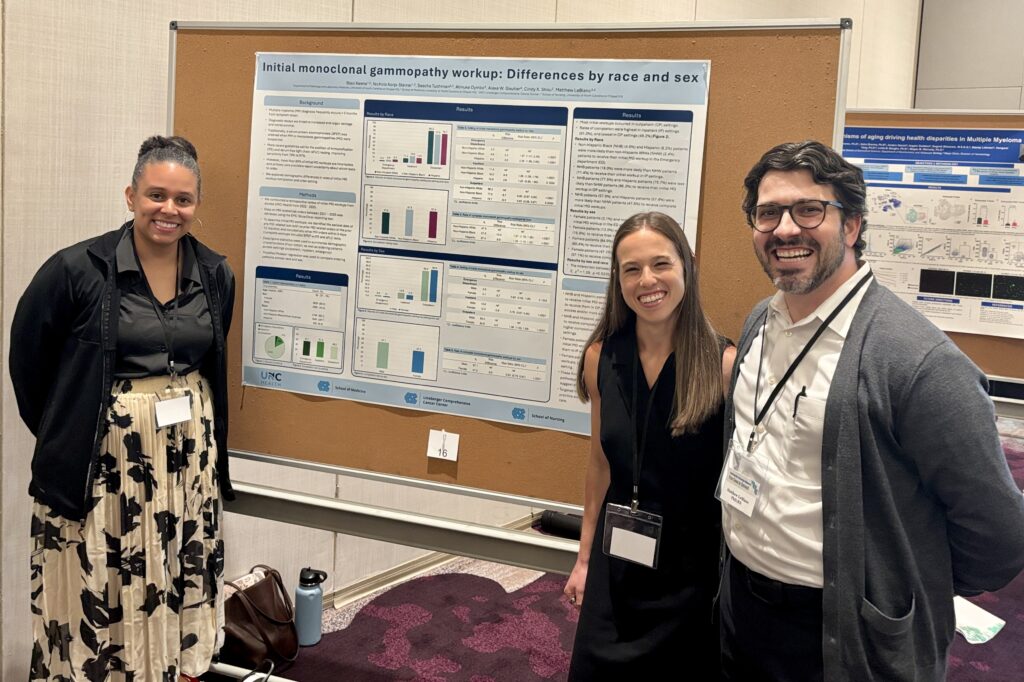
Initial monoclonal gammopathy workup: Differences by race and sex
DNP student Alexa Gautier, UNC School of Nursing faculty member Matthew LeBlanc, PhD, RN, and UNC School of Medicine faculty member Dr. Staci Keene presented their poster, “Initial Monoclonal Gammopathy Workup: Differences by Race and Sex,” at the Health Disparities in Hematologic Malignancies Conference in Atlanta, Georgia, on June 5, 2026.
Media Features
Nutrition after CRS-HIPEC: Cancer Survivor and Caregiver Experiences
Kea Turner, PhD, MPH, MA, was recently featured in the Journal of the Academy of Nutrition and Dietetics (JAND) Editor’s Podcast in an episode titled, “Nutrition after CRS-HIPEC: Cancer Survivor and Caregiver Experiences”. In the episode, JAND Editor-in-Chief Linda Snetselaar, PhD, RDN, LN, FAND, interviews Dr. Turner about her research exploring how colorectal cancer survivors and caregivers manage nutrition after cytoreductive surgery and hyperthermic intraperitoneal chemotherapy, or CRS-HIPEC.