
Publication and presentation roundup — Fall 2024
The latest scholarly work from the UNC School of Nursing
Carolina Nursing faculty, staff, and students are actively sharing their research findings on critical health care topics through publications in academic journals, presentations at national and international conferences, and features in various media outlets, including articles, podcasts, and more.
Take a look at the selection of publications, presentations, and media features below to learn more about how Carolina Nursing experts are advancing health for all by addressing the greatest health care challenges of our time.
Please note that the following list was compiled based on information submitted by our researchers and is categorized into presentations and publications.
Have a publication, presentation, or media feature to share to share? School of Nursing faculty, students and staff can submit information here to be included in the next roundup.
Publications
Pharmacogenomic Testing and Implications for Psychiatric Medication Prescribing
Rose Mary Xavier, PhD, MS, RN, PMHNP-BC, FAAN, FAANP, has published an article titled Pharmacogenomic Testing and Implications for Psychiatric Medication Prescribing in the December 2024 issue of The Nurse Practitioner. This article explores how pharmacogenomics can serve as a clinical decision support tool, enhancing the selection and dosing of psychiatric medications through personalized treatment strategies based on genetic variations.
Dr. Xavier emphasizes that while pharmacogenomic testing does not replace current prescribing practices, it provides valuable insights when integrated with traditional approaches. The publication highlights the importance of clinicians understanding the pharmacogenomic evidence base and existing guidelines to ensure safe and effective treatment for patients. This work offers an important resource for advancing precision medicine in psychiatric care.
Jennifer Leeman, DrPH, MPH, MDiV, and her research team, supported by the National Heart, Lung, and Blood Institute, recently published the study protocol in BMC Health Services Research. This study addresses a pressing health issue: hypertensive disorders in pregnancy, which are among the top causes of maternal mortality and morbidity in the U.S., especially among Black, rural, and low-income populations. The team adapted the Alliance for Innovation on Maternal Health’s Severe Hypertension Safety Bundle (HTN Bundle), traditionally used in inpatient settings, for the outpatient environment (O-HTN Bundle) to support early hypertension detection and treatment in 20 clinics serving high-risk groups.
Using a hybrid type 3 effectiveness-implementation trial with a multiple baseline design, the study aims to evaluate the implementation of the O-HTN Bundle with a multicomponent strategy that includes training, simulations, and community engagement. This approach measures clinic adherence to evidence-based guidelines for hypertension education and blood pressure technique, as well as outcomes across diverse groups to ensure equitable care. By using the Consolidated Framework for Implementation Research 2.0, this groundbreaking trial pioneers the outpatient application of the HTN Bundle and sets a standard for community-engaged, equitable care for severe hypertension during pregnancy and postpartum.
DNP student Abigail Short, her colleague Mika Kuroki, and their committee chair, Lorinda Coombs, PhD, MSN, FNP-BC, AOCNP, recently published a paper in the American Journal of Hospice and Palliative Medicine titled “Palliative Care Referral in Adult Allogeneic Hematopoietic Stem Cell Transplants: An Integrative Literature Review.” This review highlights the vital role of early palliative care (PC) referral in improving quality of life and managing symptoms for patients undergoing allogeneic hematopoietic stem cell transplants (HSCT). Their work addresses a critical gap in the literature, as PC remains underutilized in HSCT, despite its potential to support patients’ physical and psychosocial needs during challenging treatments.
Their review analyzed 19 studies, revealing that interdisciplinary palliative care can significantly enhance patient outcomes in HSCT by addressing four main themes: symptom burden, misconceptions about PC, quality of life improvements, and the value of early PC integration. The authors advocate for an integrated approach to palliative and HSCT specialties, emphasizing that early PC referral could help meet unmet needs and mitigate severe complications associated with these transplants.
Julie Jacobson Vann, PhD, MS, RN, recently had her manuscript, “Preparing Graduate Nursing Students to Lead Nursing Green Teams: Approach and Identified Greening Opportunities and Solutions,” accepted by the Journal of Advanced Nursing for the Special Issue, “Nursing for a Healthy Planet and People.” This manuscript highlights her educational initiative in the N746 – Health Care Policy and Leadership course, where students identified practical greening solutions for healthcare.
The initiative, conducted from 2021 to 2023, involved 83 students who developed real-world examples across five key environmental categories, including food management, waste minimization, green chemicals, eco-friendly purchasing, and sustainable healthcare environments. This initiative aligns with the American Association of Colleges of Nursing’s Core Competencies and fosters competency-based nursing education.
Electronic Health Record Nudges and Health Care Quality and Outcomes in Primary Care
Kea Turner, PhD, served as the senior author on a systematic review recently published in JAMA Open Network titled “Electronic Health Record Nudges and Health Care Quality and Outcomes in Primary Care.” The review, led by graduate research assistant Oliver Nguyen, MSHI, from the University of Wisconsin at Madison, analyzed findings from 54 randomized controlled trials of EHR nudges aimed at guiding clinicians toward evidence-based practices while maintaining their autonomy.
The review found that EHR nudges showed promise in improving adherence to some evidence-based practices, such as lifestyle counseling, but produced mixed results for other areas, like reducing inappropriate testing and imaging. The study was also highlighted on Medscape.
Preparing Graduate Nursing Students to Lead Nursing Green Teams: Approach and Identified Greening Opportunities and Solutions
Julie Jacobson Vann, PhD, MS, RN, has authored the manuscript, “Preparing Graduate Nursing Students to Lead Nursing Green Teams: Approach and Identified Greening Opportunities and Solutions,” which will be featured in the Journal of Advanced Nursing special issue “Nursing for a Healthy Planet and People.” This manuscript outlines an innovative educational initiative she developed and implemented in N746 – Health Care Policy and Leadership, during the fall semesters from 2021 to 2023.
The initiative guided 83 graduate nursing students through real-world green team projects, producing 178 examples of opportunities and solutions for greening health systems. Projects covered five environmental categories: food, waste management, green chemicals, sustainable purchasing, and the built environment. Her work aligns with the AACN Essentials and emphasizes competency-based nursing education.
Recognized for her clinical expertise in heart failure Leslie Davis, PhD, RN, ANP-BC, FAAN, FAANP, FACC, FAHA, FPCNA, coauthored a recently published American College of Cardiology (ACC) Expert Consensus Decision Pathway (ECDP) for Treatment of Heart Failure with Reduced Ejection Fraction. ECDPs provide clinicians practical guidance in caring for patients based on the latest evidence.
When evidence is lacking, the convened experts offer guidance to inform care. ECDP documents offer user-friendly algorithms, tables, and key points to the most pivotal aspects of caring for complex clinical situations. Dr. Davis has served as the sole nurse for this and other ACC EDCPs in the past.
Presentations
American Heart Association (AHA) Scientific Meeting
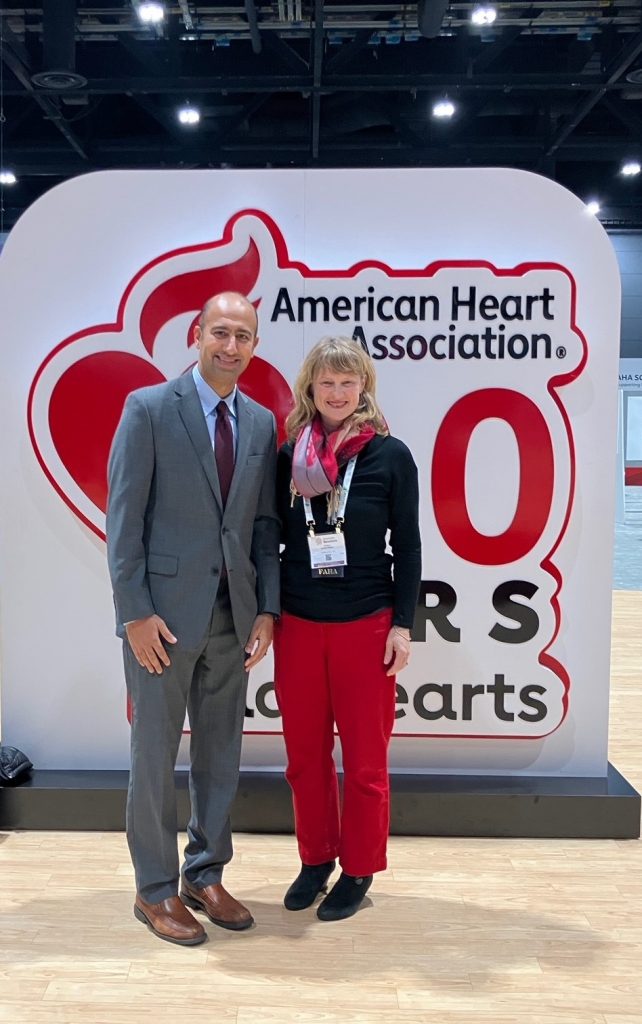
Saif Khairat, PhD, MPH, and Jessica Zègre-Hemsey, PhD, RN, FAHA, showcased groundbreaking research at the American Heart Association (AHA) Scientific Meeting in Chicago, held November 16–18, 2024.
Dr. Khairat highlighted work from the NIH-funded Center for Virtual Care Value and Excellence (ViVE), focusing on bridging health disparities through innovative virtual care solutions. He was joined by Dr. David McSwain, UNC Health Chief Medical Informatics Officer and Principal Investigator of the NIH-funded SPROUT initiative, to discuss telehealth’s role in improving pediatric health outcomes.
Dr. Zègre-Hemsey and her team presented two pivotal studies: “Uncovering Sex Bias in Machine Learning Algorithms for Detecting Acute Myocardial Infarction Using Electrocardiographic Data” and “The Presence of Arm Pain Predicts Coronary Artery Occlusion Requiring Revascularization in Patients with NSTEMI.” Their work highlights critical advances in cardiac care and equity.
“The AHA meeting was an excellent opportunity to present the cutting-edge research conducted at UNC and the School of Nursing to improve patient outcomes and health equity,” said Dr. Khairat.
Preparing Nursing Students to Lead Nursing Green Teams to Protect the Public’s Health from Environmental Risks Created by Health Services Delivery
On October 27, 2024, Julie Jacobson Vann, PhD, MS, RN, presented a poster at the American Public Health Association Annual Meeting in Minneapolis, MN. Her presentation, titled Preparing Nursing Students to Lead Nursing Green Teams to Protect the Public’s Health from Environmental Risks Created by Health Services Delivery, emphasizes the critical role of nursing students in addressing environmental health within the healthcare sector. Dr. Jacobson Vann’s poster highlights how nursing education can prepare future nurses to champion sustainable practices and tackle environmental risks associated with healthcare delivery.
How to Use AI in Nursing Education
Marlena Brokob, DNP, RN, led a breakout session at the 2024 National League for Nursing Education Summit on Sept. 19 in San Antonio, TX. Her session, titled “How to Use AI in Nursing Education,” focused on educating and motivating nurse educators on the role of artificial intelligence in nursing education. The session featured both informative and interactive elements, encouraging the integration of AI into the learning process to better prepare future nurses for a technologically advanced healthcare environment.
International Webinar on Arterial Hypertension in partnership with DHA
As a recognized expert in hypertension and Fellow in the American College of Cardiology (FACC), Leslie Davis, PhD, RN, ANP-BC, FAAN, FAANP, FACC, FAHA, FPCNA, served as co-chair for an international educational webinar on August 5, 2024 for the Department of Hypertension Arterial – Brazilian Society of Cardiology (DHA-SBC). Alongside Dr. Joao Roberto Gemelli (President of DHA-SBC), Dr. Davis co-chaired the first of two international webinars 2024 SBC-DHA Hypertension International Webinar Series.
Presentations included “Resistant Hypertension: Common Pitfalls and Challenges; Managing Hypertension, Diabetes, and Obesity; and The Interface Between Arterial Hypertension and Peripheral Arterial Disease: What We Know. The webinar was well attended by clinicians who care for patients with hypertension and other cardiovascular conditions in Brazil.
Media Features
Veteran Health, Vaccine Update
Peggy Wilmoth, PhD, MSS, RN, FAAN, was featured on The Nurse Practitioner podcast, joining Eileen Sullivan-Marx to discuss “Veteran Health, Vaccine Update.”
Hot Topic/Hot Take: Realtime Solutions for Future Nurses
Nancy Thompson, DNP, MSN-Ed, RN, and Rumay Alexander, EdD, RN, FAAN, were featured on Nurse Educator Tips for Teaching Apple Podcast in August to share insights from their recent publication on teaching strategies to introduce hot topics into an undergraduate leadership course.
Thompson outlined the overall goals of the undergraduate leadership curriculum, emphasizing the development of healthcare leaders. “We empower our students to become effective, compassionate, and innovative leaders,” she explained. Alexander added, “Leadership is more than a title.” She highlighted how integrating hot topics in healthcare bridges the gap between theory and practice, ensuring students understand both the organizational and global climate in these unprecedented times. Alexander also stressed the importance of fostering curiosity in students, encouraging them to minimize assumptions and ask thoughtful questions.