
Publication and presentation roundup — Summer 2025
The latest scholarly work from the UNC School of Nursing
Carolina Nursing faculty, staff, and students are actively sharing their research findings on critical health care topics through publications in academic journals, presentations at national and international conferences, and features in various media outlets, including articles, podcasts, and more.
Take a look at the selection of publications, presentations, and media features below to learn more about how Carolina Nursing experts are advancing health for all by addressing the greatest health care challenges of our time.
Please note that the following list was compiled based on information submitted by our researchers and is categorized into presentations and publications.
Have a publication, presentation, or media feature to share to share? School of Nursing faculty, students and staff can submit information here to be included in the next roundup.
Publications
Jessica Zègre-Hemsey, PhD, RN, FAHA, led a national interdisciplinary study on behalf of the American Heart Association’s Mission: Lifeline Systems of Care Advisory Working Group. Results of this study were published in a special issue of the journal called COVID (COVID Special Issue: Cardiovascular Effects of COVID-19: Acute and Chronic).
The manuscript title is “Treatment Times and In-Hospital Mortality Among Patients with ST-Elevation Myocardial Infarction Throughout the Waves of the COVID-19 Pandemic: Lessons Learned.” Using the American Heart Association (AHA) Get With The Guidelines–Coronary Artery Disease registry data, we evaluated (1) time metrics related to STEMI system goals and (2) regional variation in STEMI incidence and in-hospital mortality during pandemic wave time periods. The study included all patients 18–100 years old admitted with STEMI (n = 72,516) to 1 of 435 American Heart Association Get With The Guidelines–Coronary Artery Disease hospitals (1 October 2019–31 December 2021. This is the first study using a US national sample of STEMI patients and stratified by waves of the pandemic, per the CDC.
As one of two nurses on this national committee, she was the only nurse scientist serving on the committee.
Interventions to improve vaccination uptake among adults: a systematic review and meta-analysis
Over the past 28 years, Julie Jacobson Vann, PhD, MS, RN, has led a team of investigators to conduct a series of Cochrane Collaboration systematic literature reviews with meta-analyses aimed at identifying successful strategies to increase vaccination rates. In response to the coronavirus disease of 2019 (COVID-19) pandemic and because of her extensive related work, Cochrane Collaboration editors asked her to serve as co-investigator and content and methodology expert on a systematic review aimed at evaluating strategies to increase vaccination rates among adults with investigators at Cochrane South Africa and the South African Medical Research Council.
The team studied 30 types of interventions targeting recipients, providers, and health systems, including policy changes. They screened more than 12,000 articles, included 35 randomized control trials, and conducted multiple sets of meta-analyses. The manuscript was published in Preprints on May 22, 2025, and accepted for publication on July 23, 2025.
Scaffolding Clinical Judgment Using Multimodal, Unfolding Simulations
Kandyce Brennan, DNP, CNM, and Catherine Crawford, PhD, RNC-OB, have published a new article detailing a dynamic teaching strategy aimed at strengthening clinical judgment in nursing students. Their work, “Scaffolding Clinical Judgment Using Multimodal, Unfolding Simulations,” presents an innovative curriculum that blends high-fidelity manikin simulations, virtual reality scenarios, and telephone triage activities.
Grounded in the Clinical Judgment Measurement Model (CJMM), the program is designed to mirror real-life complexity in obstetric care. Each simulation unfolds in stages, challenging students to think critically, respond in real time, and adapt to evolving patient needs—just like they would in a clinical setting.
Early results show this multimodal approach not only boosts students’ confidence but also enhances their ability to make sound clinical decisions under pressure. By layering diverse learning modalities, the course supports deep learning and better prepares students to transition from classroom to bedside.
This work contributes to a growing body of evidence on the value of simulation-based learning and provides a replicable model for improving clinical reasoning across nursing education programs.
Teaching interprofessional collaboration in diabetes management: An elective course
A new peer-reviewed article co-authored by Krystal Pendergraft-Horne, DNP, FNP-C, RN, highlights a unique interprofessional course designed to enhance collaboration in chronic disease management. Published in the Journal of the American College of Clinical Pharmacy, the article details the design, delivery, and impact of a cross-disciplinary elective that brings together nursing, medicine, and pharmacy students. The course centers on patient-centered diabetes care, using case-based learning to strengthen students’ teamwork, communication, and evidence-based treatment planning.
Students who participated in the elective reported increased confidence in interprofessional collaboration and a deeper understanding of the roles and contributions of each discipline. Their care plans also demonstrated higher clinical quality and greater alignment with best practices.
“As a nurse leader and educator, it brings me immense joy to create spaces where future nurses, pharmacists, and physicians learn with, from, and about each other,” said Dr. Pendergraft-Horne. “Interprofessional collaboration is not just a competency; it’s a mindset that drives better communication, stronger teamwork, and safer, more equitable care for patients managing complex conditions like diabetes.”
Nightingale: Exemplar for the Power of Nursing
Peggy Wilmoth, PhD, MSS, RN, FAAN, published a commentary in American Nurse Journal on June 20, 2025, titled “Nightingale: Exemplar for the Power of Nursing.” Reflecting on Florence Nightingale’s legacy, Wilmoth explores how nurses can transform public trust into broader influence in policy, leadership, and systems change. Drawing on Nightingale’s strategic use of evidence, networks, and communication, the piece calls on nurses to cultivate skills beyond the bedside to shape decisions in boardrooms and legislative halls. As Wilmoth writes, “Nursing may be the most trusted of the professions, but until that trust is turned into influence beyond the bedside, it is trust wasted.”
An Evidence Map for the Women Veterans’ Health Literature, 2016 to 2023: A Systematic Review
Jean Hammer, DNP, FNP-BC, CNE, OCN, co-authored a study published in JAMA Network Open on April 22, 2025, titled “An Evidence Map of the Women Veterans’ Health Literature, 2016 to 2023: A Systematic Review.” The article presents a comprehensive analysis of 932 studies and highlights major areas of growth in research on women veterans’ health—particularly in reproductive health, mental health, pain, and suicide. The study also identifies persistent gaps in research on aging, long-term care, and evaluation of health interventions.
Research in Nursing Practice—What?
Edward Halloran, PhD, RN, FAAN, Professor Emeritus, authored an editorial in the May/June 2025 issue of Nursing Research titled “Research in Nursing Practice—What?” Building on Virginia Henderson’s foundational work—particularly her 1956 editorial “Research on Nursing Practice—When?”—Halloran revisits the enduring question of nursing’s research focus. He calls for renewed attention to Henderson’s framework of 14 fundamental human needs, originally outlined in Basic Principles of Nursing Care and later expanded in the sixth edition of Principles and Practice of Nursing. Halloran suggests that these human needs represent the profession’s domain and should guide future nursing practice, education, and research.
Patient-Reported Symptoms of Acute Coronary Syndrome in the Prehospital Period in a Prospective Study: Implications for Emergency Nurse Triage, Diagnosis, and Clinical Outcomes
Jessica Zègre-Hemsey, PhD, RN, FAHA, published the main findings of an NIH/NINR-sponsored study titled “Patient-reported symptoms of acute coronary syndrome in prehospital cardiac care” (Grant 1K23NR017896, 2019–2024).
Conducted in collaboration with Orange County Emergency Services (OCES), the study enrolled 309 participants, 206 of whom were transported by EMS. This was the first known study to use a prospective approach to better understand the very early period of evolving acute myocardial ischemia or infarction among individuals transported by ambulance for cardiac symptoms. A staged consent strategy for emergency care research was implemented, as recommended by the NIH Office of Emergency Care Research and the Department of Bioethics. Participants were approached in the back of the ambulance and upon arrival to the emergency department.
Nursing Care Management and Glycemic Control Among Children With Diabetes Enrolled in Medicaid
Julie Jacobson Vann, PhD, MS, RN, worked with colleagues at the UNC-Chapel Hill School of Medicine on an intensive care management intervention led by a nurse practitioner to improve glycemic control and self-care outcomes for youth with uncontrolled diabetes. The description and results of the project were published in the Journal for Specialists in Pediatric Nursing on May 6, 2025
The intervention consisted of telehealth visits, emails, and MyChart messages with patients and caregivers to supplement in-clinic visits. Therapeutic communication skills were applied, including motivational interviewing techniques and unconditional positive regard. Mean participant (n = 12) HbA1c levels dropped by 1.5 percentage points from baseline (12.8%) to the six-month study end point (11.3%). Seventy-five percent of participants experienced a decrease in HbA1c.
This study adds to the published literature by focusing on youth with challenging family circumstances and sociodemographic factors that have been linked with poor glycemic control, such as having Medicaid insurance, living in multiple households, and non-white race. In our study, more than 80% of children lived in single-parent households; nearly 60% had comorbid psychiatric conditions, and one-third had previous interventions with social services.
Carolina Nursing Postdoctoral Fellow Natasha Burse, DrPH, MS, co-authored a study published in Cancer Medicine that examined changes in physical activity among nearly 3,000 breast cancer survivors enrolled in the Carolina Breast Cancer Study Phase 3—half of whom were Black women. The research found that while moderate to vigorous physical activity (MVPA) dropped sharply six months after diagnosis, it rebounded by 18 months. Factors like income, education, BMI, cancer stage, and neighborhood conditions were linked to MVPA levels, with notable disparities by race. The findings highlight the need for targeted interventions to support equitable recovery and long-term survivorship.
Generative AI in Nursing Education: Ethical and Sustainable Use for Educators and Students
Kandyce Brennan, DNP, CNM, published a teaching tip in Nurse Educator. In this piece, Dr. Brennan outlines a practical framework to help nurse educators and students balance the educational benefits of AI tools with their environmental impact. The tip includes strategies for defining boundaries, evaluating outcomes, and maintaining human oversight—all aimed at promoting responsible and sustainable integration of generative AI in nursing education.
Presentations
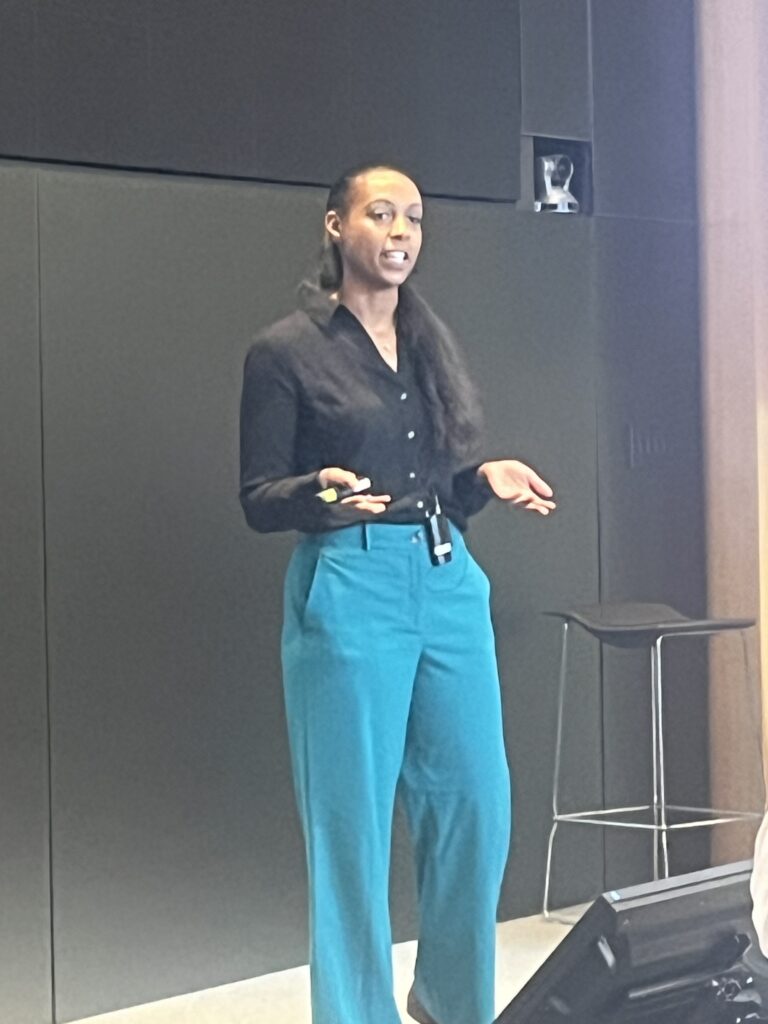
AI and the Future of Health Care
Kandyce Brennan, PhD, CNM, presented “AI and the Future of Health Care” to the Graduate Nursing Student Association in Washington, D.C., on July 31, 2025. Her talk explored the transformative potential of artificial intelligence in advancing health care delivery, education, and innovation.
Dr. Brennan discussed current and emerging AI applications in clinical settings, including predictive analytics, decision-support tools, and personalized care models. She highlighted both the opportunities and ethical considerations associated with AI integration, emphasizing the importance of responsible adoption to improve patient outcomes and reduce health disparities.
Her presentation underscored the UNC School of Nursing’s commitment to digital innovation and showcased how nurse leaders can play a pivotal role in shaping the future of AI in health care.
Integrating Competency-Based Education (CBE) Strategies and AI to Enhance Community and Public Health Nursing Education
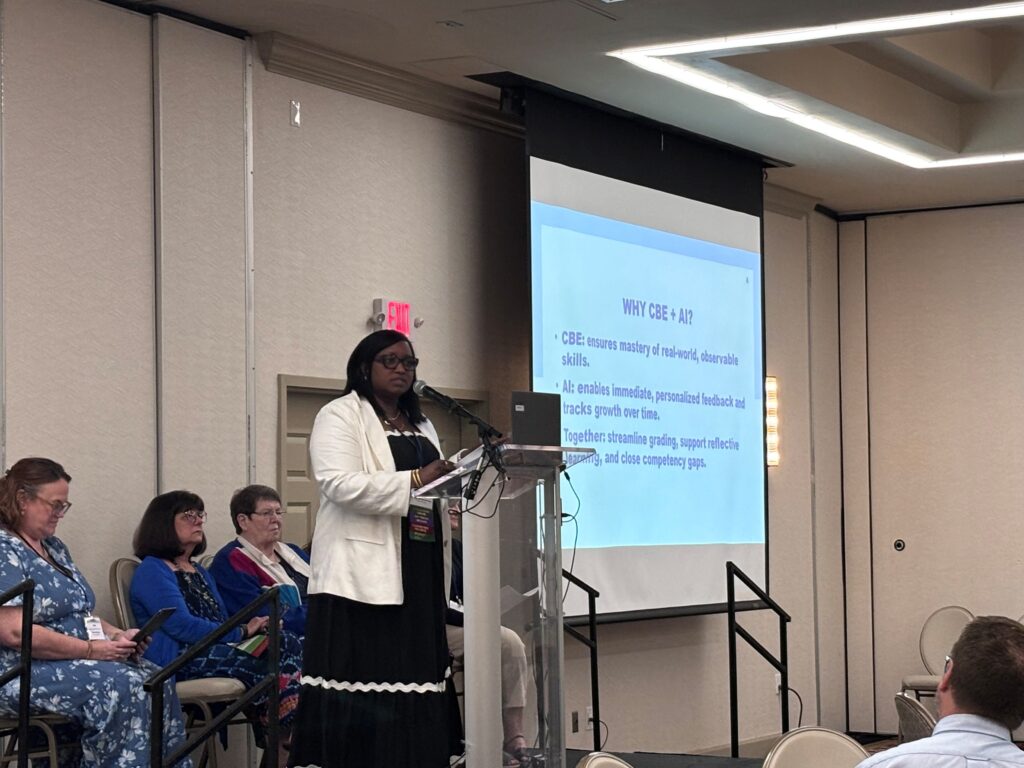
Stephanie Fisher, DNP, MSN, RN, Assistant Professor at the UNC School of Nursing and Co-Chair of the Education Committee for the Association of Community Health Nurse Educators (ACHNE), recently developed and led a national plenary session titled “Integrating Competency-Based Education (CBE) Strategies and AI to Enhance Community and Public Health Nursing Education.” The session brought together diverse faculty from across the country to explore how CBE and artificial intelligence can be used to create more personalized, equitable, and practice-ready nursing education.
Panelists shared strategies for aligning CBE and AI with AACN Essentials, using tools like chatbots, virtual patients, and predictive analytics to enhance student engagement and critical thinking. The session also addressed faculty development, ethical considerations, and the use of AI to track competencies and close equity gaps. Survey data from ACHNE’s Education Committee highlighted both enthusiasm and challenges in adopting these innovations. The session advanced both competency-based education and the thoughtful integration of artificial intelligence into nursing education and practice.
Moving forward, there is a continued commitment to developing inclusive, forward-thinking educational strategies that enhance community and public health nursing across diverse settings. Insights from the session will inform the development of a faculty resource guide from ACHNE on best practices in public health nursing education.
Integrated Supportive and Nutrition Care Program for Older Adults with Advanced Pancreatic Cancer: A Feasibility Study
Kea Turner, PhD, MPH, MA, and Emma Hume, MPH, presented at the 2025 ASCO Annual Meeting on “Integrated Supportive and Nutrition Care Program for Older Adults with Advanced Pancreatic Cancer: A Feasibility Study.” Their presentation shared findings on the feasibility and acceptability of implementing early supportive care and nutrition interventions for older adults beginning chemotherapy. The published conference abstract is available here.
Integrating Generative AI into Nursing PhD Education: A Pedagogical Innovation for Enhancing Student Engagement with Theory in Research
Becky Salomon, PhD, RN, PMHNP-BC, presented “Integrating Generative AI into Nursing PhD Education: A Pedagogical Innovation for Enhancing Student Engagement with Theory in Research” at the 2025 Congress of the International Council of Nurses in Helsinki, Finland. The presentation was supported in part by a 2024–2025 CFE/Lenovo grant for the GenIE project, which focuses on discipline-specific faculty development around generative AI in education.
The Use of Generative Artificial Intelligence (AI) to Improve Efficiency, Education, and Patient Care at the UNC School of Nursing Mobile Health Clinic
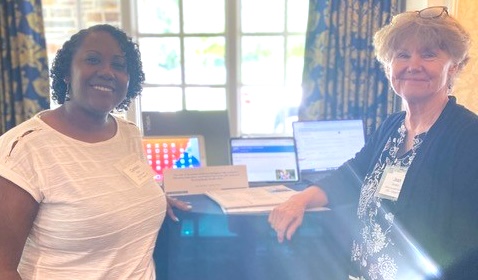
Jean Davison, DNP, FNP-BC, FAANP, and Carman Price presented at the Triangle AI Summit – Teaching with AI Showcase at Duke University in May 2025. Their session, “The Use of Generative Artificial Intelligence (AI) to Improve Efficiency, Education, and Patient Care at the UNC School of Nursing Mobile Health Clinic,” highlighted how AI tools are being integrated into clinical education and outreach. Attendees had the opportunity to interact with the clinic’s Co-pilot Agent, the “UNC Health Assistant,” with many noting its potential to enhance patient education and engagement.
Preparing Nursing Students to Lead Green Teams
Julie Jacobson Vann, PhD, MS, RN, presented virtually on May 21, 2025, to members of the Association of Community Health Nursing Educators. Her presentation, “Preparing Nursing Students to Lead Nursing Green Teams,” covered key topics in environmental and planetary health, including the nursing profession’s role in addressing health care’s environmental impact. The session explored strategies for teaching students to lead green teams, along with practical solutions and opportunities to reduce the sector’s ecological footprint. Attendees from across the country expressed enthusiasm for incorporating Dr. Vann’s Green Team assignment into their own curricula and onboarding efforts.
Evaluating Culturally Adapted MHFA Training in Immigrant Chinese Americans
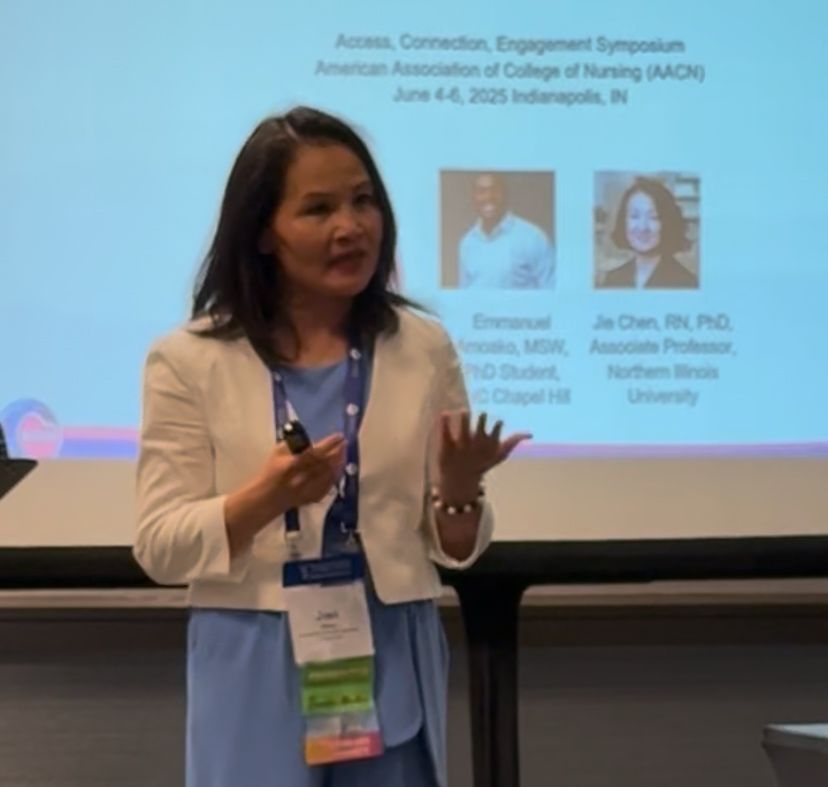
Lily Chen, PhD student, was selected to give a podium presentation at the AACN Access, Connection, Engagement (ACE) Symposium for her study, “Evaluating Culturally Adapted MHFA Training in Immigrant Chinese Americans.” The study assessed the effectiveness of Chinese-language Mental Health First Aid (MHFA) training on mental health knowledge, beliefs, and attitudes. While knowledge scores did not show significant change, belief and attitude scores improved post-training.
Co-presenters include Emmanuel Amoako, MSW, Royster Fellow at the UNC School of Social Work, and Jie Chen, PhD, of Northern Illinois University School of Nursing. The study was funded by the National Council for Mental Wellbeing and advised by Dr. Cheryl Giscombé.
Nurse Practitioner Spring Symposium
Several Carolina Nursing faculty presented at the 2025 NCNA Nurse Practitioner Spring Symposium, held April 13–15 at the Wilmington Convention Center in Wilmington, NC. Their contributions spanned a range of timely topics in practice, education, and innovation:
- “An AI-Powered Decision Aid for Advancing Women’s Health Choices” — Kandyce Brennan, DNP, CNM
- “Parentification: Identify, Assess, Activate Support, and Advocate”— Leslie Sharpe, DNP, FNP-BC
- “Latent TB: Spot It, Stop It, Save Lives” — Rachel McInerney, DNP, FNP-BC, PMHNP-BC, RN
- “Panel Discussion: Supporting New Graduate NPs Transitioning into Practice” — Tracy Vernon-Platt, DNP, ANP-BC